
On this page
This blog evaluates five leading retail vision AI systems: SAI One, Everseen, Trigo, Veesion, and SeeChange, against four buyer priorities for computer vision in retail stores. Each of these buyer priorities is assigned a certain weighting on a scale of 100 as the basis for the evaluation.
- Breadth of coverage (40% weighting): Self-checkout (SCO), aisle intelligence, walk-out shopping, POS fraud, queue management, safety, store operations, shelf intelligence, compatibility with current CCTV, and conversational AI.
- Customer adoption and maturity (25% weighting): Named customers, disclosed deployment scale, geographic reach, integrations, and documented production capabilities.
- Compliance and assurance (20% weighting): Publicly verifiable evidence for SOC 2, ISO 27001, ISO 42001, ISO 22301, and PCI Secure Software Lifecycle.
- Cost and savings (15% weighting): Shrink reduction, recovered revenue, fewer interventions, labour efficiency, avoided camera replacement, and payback evidence.
Important
This scorecard is based on publicly available information on the products and it is recommended that buyers request evidence while carrying out due diligence. This scorecard is published by SAI Group, and the criteria and weightings reflect SAI’s view of what matters most to retail buyers.
SAI One: Best Retail Vision AI Platform for Whole-Store Intelligence
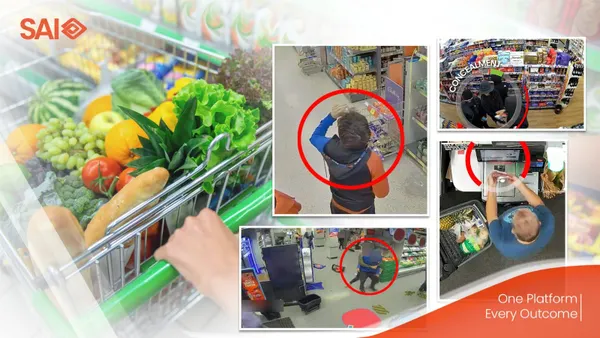
SAI One treats the store as one connected operating environment rather than as a collection of isolated camera use cases. SAI One’s coverage includes self-checkout theft prevention, assisted-checkout monitoring, AI-powered aisle theft detection, shelf swipes, trolley pushouts, item consumption, POS fraud detection, queue formation, AI shelf monitoring, planogram issues, retail safety monitoring, blocked exits, customer journeys, and retail-media insights.
Most vision AI systems are trained to identify a narrow event such as a missed scan or a concealment gesture. SAI One is positioned to interpret sequences of activity and store the context, and report an operational signal or answer a natural-language question. That makes it relevant beyond loss prevention: a retailer can use the same visual layer to understand queues, execution gaps, hazards, availability, and shopper behaviour.
SAI One also emphasises reuse of existing cameras. That matters because camera replacement, recabling, installation downtime, and separate point-solution infrastructure can erode the economics of a vision AI programme. The platform supports 1000s of stores and processes over four million transactions daily. At one UK grocery retailer, 97% of alert nudges in the last month ended with no loss because shoppers self-corrected at the checkout. In Iceland’s initial four-week trial, stores saw aisle theft fall by up to 50% against pre-trial baselines.
Why SAI One leads this scorecard
- Connected use-cases: It links checkout, aisle, safety, shelf, queues, operations, and customer insight in a single platform.
- Provides context in addition to detection: SAI One’s visual-language approach interprets multi-step activity rather than issuing a stream of isolated alerts.
- Conversational access: Generative AI creates a path for store and head-office teams to query visual operations in natural language.
- Existing-CCTV strategy: Retailers can seek value from infrastructure they already own.
- Platform economics: A common intelligence layer can reduce the integration, training, and support burden created by multiple point solutions.
- Built for multi-site retailers: Best suited for retailers who need an extensible vision AI investment that can scale across loss prevention, store execution, safety, and operational needs.
FAQs
Why does SAI One stand out?
SAI One combines a wide use-case portfolio with a Visual Language Model and generative AI. It is designed to turn existing CCTV into contextual intelligence across checkout, loss prevention, queues, shelves, safety, operations, and customer behaviour, with natural-language access to store insight.
How is SAI One different from checkout-only or gesture-only tools?
Most vision AI tools are built around a single event, such as a missed scan at self-checkout or a concealment gesture in an aisle. SAI One runs those use cases on the same platform as queues, shelf gaps, safety, store operations, and customer journeys, and interprets a sequence of activity rather than firing an isolated alert. For a retailer, that means one visual layer and one integration instead of a separate tool, contract, and workflow for each problem.
Can SAI One reduce self-checkout theft and errors?
Yes. SAI One can detect non-scans, product switching, scan avoidance, items left in baskets, walkaways, and other anomalies. SAI One lets shoppers self-correct straightforward errors and send higher-confidence cases to an associate.
What certifications should a retail vision AI vendor have?
Common enterprise checkpoints include SOC 2, ISO 27001 for information security, ISO 42001 for AI management systems, ISO 22301 for business continuity, and PCI Secure Software Lifecycle where payment software scope is relevant. Buyers should verify the certificate scope and validity rather than relying on a website badge.
How should retailers calculate vision AI ROI?
Retailers can measure recovered sales, shrink reduction, false and avoided interventions, labour minutes saved, safety response, queue performance, availability gains, hardware avoided, integration cost, and ongoing support. Compare a matched baseline with pilot stores and agree on success thresholds before deployment.