
On this page
What Is an Organised Retail Crime (ORC) Alert System?
Understanding Organised Retail Crime
Organized Retail Crime (ORC) is a coordinated threat posed by groups that steal large volumes of merchandise, move it through resale channels, and operate across regions and stores. For retail chains, ORC is not just a loss-prevention issue. It affects store profitability, employee safety, customer trust, inventory accuracy, supply chain operations, and brand reputation.
The National Retail Federation describes ORC as large-scale theft conducted for financial gain and involves structured groups that collect and redistribute stolen goods. Recent NRF reports highlight a sharp increase in shoplifting incidents, theft-related violence, and supply chain theft.
Why Retailers Need an Organised Retail Crime Alert System
An Organised Retail Crime Alert System is an intelligence layer that can monitor activity, detect anomalies, prioritize risk, and trigger timely action. For example, an AI-based ORC alerting system can flag repeated bulk removals of a particular product category, suspicious refund patterns, unusual similarities in theft patterns across multiple stores, rapid shelf depletion, or known offender activity across locations.
Key Attributes of an ORC Alert System
- Timely, actionable alerts: Instead of waiting for a weekly report, loss-prevention teams can be alerted while the situation is still actionable.
- Avoid alert fatigue: Retail environments generate huge volumes of data, but not every exception is meaningful. As too many alerts can lead to fatigue among store personnel, the alerting system needs to rank events by severity, confidence, location, product value, repeat behavior, and potential safety risk. This helps teams focus on the incidents most likely to represent organized activity. It also improves consistency, so that a pattern detected in one region can be recognized across the chain.
- Speedy intervention: When store leaders, asset-protection teams, distribution centers, and field managers receive timely alerts, they can adjust staffing, monitor targeted aisles, secure vulnerable products, notify nearby stores, document evidence, and coordinate with law enforcement where appropriate. The result is a shift from reactive investigation to proactive risk management.
Why UK Retailers Need a Shoplifting Alert System
Growing Retail Theft Challenges in the UK
The British Retail Consortium’s 2025 Retail Crime Survey reported:
- More than 20 million theft incidents in 2023/24
- Over 55,000 incidents per day
- Losses of over £2.2 billion
- Rise in violence and abuse against retail workers exceeded 2,000 incidents per day
- A record spend of £1.8 billion by retailers on crime prevention measures.
The Association of Convenience Stores’ 2025 Crime Report also shows the pressure on UK local shops:
- 6.2 million incidents of shoplifting reported in the convenience sector
- Total crime cost of £316 million.
Importantly, many incidents are increasingly linked to organised groups systematically targeting multiple stores. ORC is not an isolated security issue anymore; it is a national retail resilience challenge that requires faster detection, better intelligence sharing, and coordinated response across store networks.
How Retail Loss Prevention Software Reduces Shrinkage
Shrinkage can be attributed to external theft, employee theft, administrative errors, supplier issues, damaged goods, and process gaps. When such signals reside in disparate systems, retailers may only discover the problem after inventory counts, audits, or financial reports.
An effective retail loss prevention software can connect point-of-sale data, inventory movement, returns, refunds, video events, incident reports, and store activity to enable teams to identify unusual patterns earlier. The software can flag transactions that do not match normal behavior, such as excessive voids, repeated refunds without receipts, unusual discounting, suspicious employee overrides, or high-risk returns.
It can also compare sales and inventory data to detect rapid shelf depletion, unexplained stock variance, or recurring losses in specific categories.
Instead of relying on manual review, asset-protection teams receive prioritized alerts that show where shrinkage is likely occurring and why it matters.
Loss prevention software also improves response speed and consistency by providing a shoplifting alert system. Store teams receive clear guidance on how to respond to different risk events, while regional managers can see whether the same pattern is emerging across multiple locations. Integrated case management helps investigators organize evidence, link related incidents, document actions, and track outcomes. Over time, analytics reveal which products, stores, time periods, and processes create the highest shrink risk, allowing retailers to adjust merchandising, staffing, training, replenishment, and security controls.
By moving loss prevention from reactive review to continuous monitoring, retailers can reduce theft, prevent repeat incidents, improve inventory accuracy, and protect margin. The strongest platforms do more than detect losses; they help teams prevent them by combining analytics, workflows, alerts, and accountability into one operating model.
Key Features of an Organised Retail Crime Alert System
- AI-Powered Video Analytics for Real-Time Detection
- AI-powered video analytics
- Instant HHT Alerts for Store Staff
- Repeat Shoplifter Detection with AI
Store-to-Store Communication for Faster Response
Organized Retail Crime (ORC) typically involves repeat offenses which can impact multiple stores within a short timeframe. When a preplanned series of high value theft is executed across an entire neighbourhood, the damage can be severe as the store security teams are caught unaware. In such a scenario, secure and discreet communication between stores is important to prevent large-scale shoplifting.
A store-to-store communication system carries out three important actions:
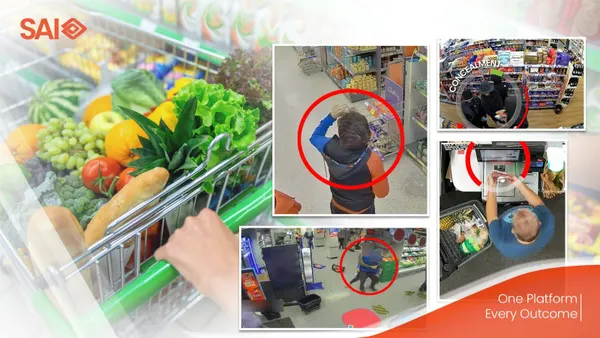
- Detection: AI-powered video analytics monitor live feeds for suspicious customer behavior detection. For instance, SAI’s visual AI platform can identify concealment of items, loitering, or repeated theft patterns. The system uses gesture, movement analysis and counting to detect incidents of shoplifting.
- Identification: When a shoplifter is detected, the platform tags the incident and the individual.
- Broadcasting: When an organized retail crime is detected, the platform raises a notification on the handheld terminals (HHT) of the store staff along with the information on the incident. Based on a store staff’s input on the HHT, the system sends a secure, cloud-based organized retail crime alert, which includes an image of the offender, to all stores of the retail chain that are within a specific distance. Authorized store staff can configure the distance for the broadcast message.
- Staff Notification: Store staff and security teams receive alerts on handheld terminals or dashboards, enabling them to prepare and intervene proactively.
How the System Works
AI Detects Suspicious Behaviour
AI-powered video analytics monitor live feeds for suspicious customer behavior detection. For instance, SAI’s visual AI platform uses AI-powered video analytics to identify concealment of items, loitering, or repeated theft patterns. The system uses gesture, movement analysis and counting to detect incidents of shoplifting. When a shoplifter is detected, the platform tags the incident and the individual.
Staff Receive Instant HHT Alerts
When an organized retail crime is detected, the platform raises a notification on the handheld terminals (HHT) of the store staff along with the information on the incident. Based on a store staff’s input on the HHT, the system sends a secure, cloud-based organized retail crime alert, which includes an image of the offender, to all stores of the retail chain that are within a specific distance. Authorized store staff can configure the distance for the broadcast message.
SOC Monitors and Coordinates Responses
The platform provides broadcast operations features that Retail Security Operations Centres (SOC), regional managers and loss prevention teams can use to gain unified visibility across all locations, enabling them to track incident rates and responses. SOC can help retailers mount coordinated responses to multiple theft attempts and better prepare stores in risk-prone areas to meet potential threats before they materialize.
Benefits for Retailers
Reduce Theft and Shrinkage
Retail loss prevention software enables real-time detection and coordinated response to minimize inventory losses and deter habitual offenders. Alerts are delivered on the HHTs used by the store staff. As a result, recipients do not need to worry about what broadcasters are on, or which broadcast media they need to track for alerts. As retail store staff are very familiar with using HHTs, which are deployed extensively in retail store chains, they do not need any additional training to make use of the system.
The system works seamlessly across hundreds of locations, leveraging existing camera infrastructure without costly hardware upgrades. The software also stores video clips and incident logs for reporting and prosecution, streamlining legal processes.
Improve Staff Response Time
The Organised Retail Crime Alert System alerts staff before a repeat offender enters their store, allowing for preventive action rather than reactive investigation. As authorized users at each store can configure the area for broadcast communication, the chances of the store network getting overwhelmed by a large number of alerts are remote. AI-driven alerts and store staff validation help reduce monitoring fatigue, allowing staff to focus on genuine threats.
The broadcast feature provides a common, virtual network available on the fingertips of the store staff and every store becomes a critical node in this broadcast communication network.
Protect Revenue and Customer Experience
Real-time detection and coordinated response minimize inventory losses and deter habitual offenders. As security teams are better prepared, the system reduces the risk of confrontations and violence in the store premises.
Conclusion
Organised Retail Crime is becoming more sophisticated, making traditional loss prevention methods increasingly ineffective. Retailers need a proactive approach that combines AI-powered video analytics, real-time alerts, intelligent risk detection, and seamless store-to-store communication to identify and respond to threats before losses escalate.
An advanced Organised Retail Crime Alert System enables retailers to detect suspicious behaviour early, coordinate faster responses across multiple locations, reduce shrinkage, improve staff safety, and protect customer experience. By transforming fragmented data into actionable intelligence, retailers can strengthen loss prevention strategies, improve operational efficiency, and build a more secure and resilient retail environment in the face of growing organised retail crime.
FAQs
Q. What is an Organised Retail Crime Alert System?
An Organised Retail Crime Alert System can detect a shoplifting pattern that can potentially impact multiple retail stores within a short period of time.
Q. How does repeat shoplifter detection work?
SAI’s visual AI platform uses video analytics to carry out repeat shoplifter detection. When a shoplifter is detected, the platform tags the incident and the individual and includes this information while broadcasting to other stores in the vicinity.
Q. What are handheld terminal (HHT) alerts in retail?
When a shoplifter is detected, the platform tags the incident and the individual and raises real-time, handheld terminal (HHT) alerts so that retail store staff can initiate further action to contain the situation.
Q. How does AI-powered video analytics improve retail security?
AI-powered video analytics help retail stores quickly detect shoplifting trends and enable store staff and security personnel to respond quickly.
Q. Why do UK retailers need a shoplifting alert system?
The financial exposure that retail crime poses to UK retailers is exceeding billions of pounds. An effective shoplifting alert system is therefore a necessity for retail stores across the UK.