On this page
UK shoppers expect fast, convenient, and predictable in-store journeys. As a result, when they find a checkout line that appears too long or disorganized, many customers abandon their basket, delay the purchase, or decide to choose a competitor. For retailers already managing rising labour costs, fluctuating footfall, and growing pressure from online shopping, queue delays can quickly affect both revenue and customer loyalty.
The rising deployment of AI queue management systems across supermarkets, grocery stores, pharmacies, fashion retailers, shopping centres, and department stores are clear indicators that retailers are focused on addressing these challenges. Instead of relying only on manual observation, AI-powered retail queue management solutions enable retailers to monitor queues in real time, understand customer movement, and respond before congestion becomes a problem.
In a competitive retail market, smart queue management is no longer just an operational task; it is an essential part of delivering better customer experience.
What is an AI Queue Management System?
A queue management system is a technology solution that helps retailers organise, monitor, and improve customer experience when customers need to wait to get service. Typical choke points where customers need to wait include checkout lanes, service counters, counters handling returns, fitting rooms, and click-and-collect areas.
While traditional methods focus on basic queue control, using ticketing or manual staff allocation to tackle the situation, AI turns queue activity into live operational intelligence.
An AI queue management system uses technologies such as computer vision, machine learning, and analytics to do the following:
- Detect queue length
- Estimate waiting times
- Track customer flow
- Identify bottlenecks
- Alert store teams when additional tills should be opened
- Show managers where congestion is building
- Provide historical data for better planning.
The result is a smarter, faster, and more responsive approach to retail queue management.
Why queue management matters for UK retailers
Retail queue management directly affects how customers feel about a store. Product availability and strong pricing notwithstanding, poor checkout or service experience can create frustration at the final stage of the customer journey. Long queues make customers feel that their time is not being respected; unclear waiting times worsens the customer experience.
Queue delays can lead to basket abandonment, missed upsell opportunities, negative reviews, and lower repeat visits. Add to this, the pressure on staff, especially during weekends, holidays, sales events, and seasonal peaks. A well-managed queue helps teams work more efficiently, keeps customers moving, and supports a profitable store environment.
How AI queue management works
Real-time queue detection
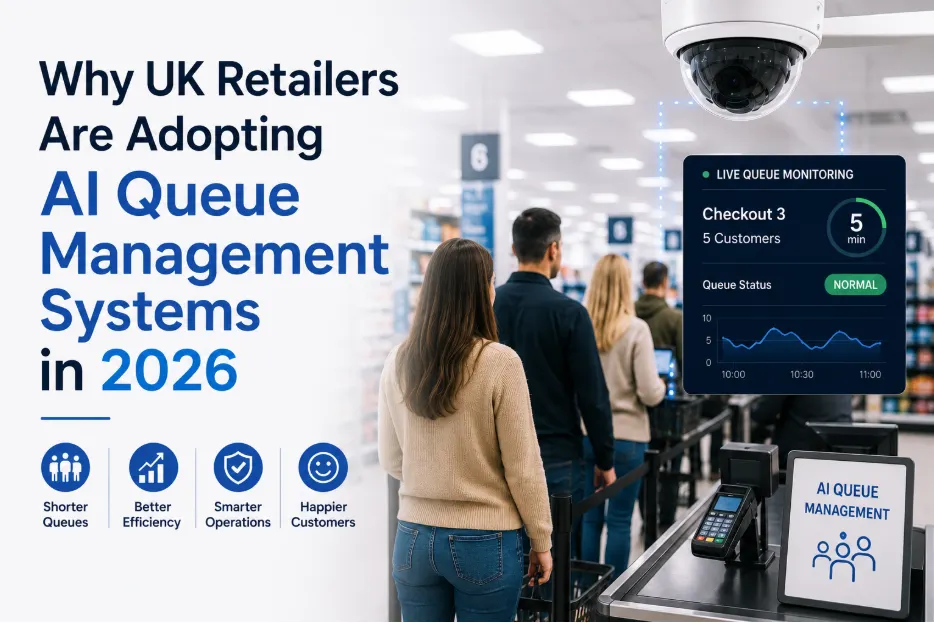
AI queue management begins with real-time detection. Using the store’s CCTV feeds, the system can identify how many customers are waiting, how quickly the lines are moving, and when a queue crosses a predefined threshold. This gives store teams an objective view of what is happening instead of relying on random manual checks.
Customer flow analysis
Beyond the checkout, AI can analyse how people move through the store. It can highlight high-traffic zones, slow-moving areas, and customer flow patterns from entry to purchase. Such insights help retailers improve store layout, product placement, staffing, and service design.
Automated staff alerts
One of the biggest advantages of AI queue management is automation. When a queue starts to grow, managers or supervisors receive real-time alerts recommending action, such as:
- Opening an additional till
- Redirecting staff
- Adjusting service coverage.
This helps teams respond proactively rather than waiting for complaints.
Live dashboards and performance reporting
Live dashboards provide managers with a clear view of queue health across one store or multiple locations. Historical reports can show peak hours, average waiting times, checkout throughput, and recurring bottlenecks. Over time, these insights support better staff scheduling, operational planning, and customer experience improvements.
Key benefits of smart queue management
Smart queue management helps retailers improve both customer-facing service and back-office decision-making. The most immediate benefit is the reduced waiting time for customers. When teams know exactly when and where queues are formed, they can act faster and keep the service moving smoothly.
Smart queue management offers the following benefits:
- For customers: Shorter queues increase the likelihood of shoppers completing their purchases, while better customer flow creates more opportunities for browsing and impulse buying.
- For staff: AI-driven insights support better workforce allocation, helping retailers avoid both understaffing and unnecessary labour costs.
For leadership teams: Queue data creates a stronger foundation for decisions across store operations, performance management, and future planning.
Features to look for in an AI Queue Management System
When choosing a queue management system, retailers should look for capabilities that fit their current operations and future growth plans.
Key capabilities of a queue management system include:
- AI-powered queue detection that works with existing CCTV infrastructure
- Real-time alerts to help managers respond before queues affect customer experience
- Heatmaps
- Customer traffic analytics
- POS integration
- Multi-store dashboards
- Historical reporting
- Cloud-based monitoring.
Retailers with multiple locations need to prioritise scalable systems that can provide consistent visibility across all stores. The best solution is not the one that simply shows that a queue exists; it needs to explain what is causing the queue and what action should be taken.
Industries that benefit from AI queue management
AI queue management systems are especially useful in retail environments that see high footfall.
- Supermarkets and grocery stores can use them to reduce checkout congestion during busy hours.
- Fashion retailers can apply queue insights to fitting rooms and service desks.
- Electronics stores can manage specialist consultations more effectively, while pharmacies can improve prescription collection and customer service queues.
- Shopping centres and department stores can manage several queue points simultaneously.
By using AI to monitor customer flow across different areas, these businesses can improve safety, comfort, and operational performance throughout the store.
Common queue management challenges and how AI solves them
Peak-hour congestion, checkout bottlenecks, staff shortages, inconsistent customer flow, and long waiting times are some of the common challenges in queue management for retail stores. These issues cannot be addressed solely with manual observation because conditions can change quickly at any time during the day.
AI provides a proactive solution by continuously monitoring conditions and identifying patterns that humans can potentially miss.
- If queue buildup occurs at the same time each day, the system can support better staffing decisions.
- If one checkout area is consistently slower, managers can investigate the cause.
- If customer flow changes during promotions or seasonal events, AI can help teams adapt faster.
Why UK retailers are investing in AI queue management in 2026
As labour costs remain a major concern, retailers need better ways to deploy staff where they add the most value. Customer expectations are rising and shoppers increasingly compare in-store convenience with the speed of digital channels.
The growth of self-checkout, omnichannel shopping, and digital transformation is also changing how stores operate. Retailers need systems that can connect physical activity with digital insight.
AI queue management supports this shift by helping retailers reduce friction, improve service levels, and make faster decisions based on real-time data.
Why choose SAI for AI queue management
SAI helps retailers move from reactive queue handling to proactive, AI-driven customer flow optimisation. SAI’s AI-powered queue management solution can work with existing CCTV infrastructure, making it easier for retailers to modernise without completely rebuilding their store technology.
As SAI’s solution provides real-time alerts, actionable analytics, and scalable reporting, store teams can identify issues quickly and make informed decisions across single or multi-store operations.
For UK retailers, SAI offers a practical way to improve checkout performance, staff utilisation, and customer satisfaction. Whether the goal is to reduce waiting times, understand customer movement, or to build a more efficient store network, AI queue management provides the visibility needed to take informed decisions.
Ready to improve your retail queue management? Get a demo from SAI or speak with our team to see how AI queue management systems can support your stores in 2026.
Conclusion
AI queue management is not just a technology upgrade. Smart queue management helps retailers create faster, smoother, and more profitable store experiences by combining real-time monitoring, automated alerts, customer flow analytics, and performance reporting.
As United Kingdom retailers prepare for the future of in-store shopping, those that invest in AI queue management systems will be better positioned to meet customer expectations, improve operational efficiency, and stay competitive in 2026 and beyond.
FAQ
Q. What is an AI queue management system?
An AI queue management system uses artificial intelligence, video analytics, and real-time data to monitor queues, estimate waiting times, detect congestion, and help retailers improve customer flow.
Q. How does AI queue management improve customer flow in retail stores?
AI queue management tracks live movement across key areas, identifies bottlenecks, and alerts staff when action is needed. This helps customers move through the store more smoothly and reduces unnecessary waiting.
Q. How does an AI queue management security system enhance retail security?
When integrated with existing CCTV, AI queue management can improve visibility across busy areas, reduce overcrowding, and enable teams to respond quickly to unusual congestion or service pressure.
Q. What are the benefits of using queue management AI for UK retailers?
Benefits include shorter waiting times, improved customer satisfaction, better staff allocation, increased sales opportunities, stronger operational visibility, and more data-driven decision-making.
Q. How does AI queue management automation reduce customer waiting times?
Automation reduces waiting times by detecting queues early, sending alerts to staff, recommending when to open additional counters, and helping managers plan staffing around real demand.
Q. Can an AI queue management system integrate with existing CCTV and security systems?
Yes, SAI’s queue management solution uses existing CCTV infrastructure to monitor queues and customer flow, reducing the need for major hardware changes.
Q. Why are businesses investing in AI queue management solutions in 2026?
The key drivers for businesses to invest in AI queue management include quicker service, better customer experience, improved staff productivity, and increased competitiveness in a digitally driven retail market.