On this page
Retailers introduced self-checkouts to reduce queues, and to improve convenience and operational efficiency. However, self-checkouts also introduced new risks in the form of missed scans, barcode switching, mislabeling, intentional non-scans, payment errors, and walkouts.
Such risks can quickly turn a high-efficiency front end into a major source of retail shrink.
Moreover, even honest customer mistakes that are not corrected can add up quickly across multiple stores, leading to aggravated shrink figures. As a result, effective self-checkout loss prevention is no longer optional for retailers; it is a critical part of protecting margins while maintaining a smooth customer experience.
Unique loss prevention challenges in self-checkout
Traditional checkout lanes rely on trained cashiers to scan items, verify quantities, notice suspicious behavior, and resolve pricing or payment issues. With self-checkout, much of that responsibility to the shopper as there is no human oversight from the retailer’s side. This leads to both accidental and intentional losses.
For instance, a customer may forget an item at the bottom of the cart, enter the wrong produce code, or accidentally scan only one item in a multi-pack. At the same time, there could be others who may try to exploit the process through deliberate tactics such as item skipping, barcode swapping, or scanning a low-cost product while bagging a more expensive one.
The challenge for retailers is to achieve the right balance between implementing strong controls and enabling a frictionless shopping experience for genuine customers. If controls are too weak, shrink rises. If controls are too aggressive, customers become frustrated and associates may end up spending too much time clearing false alerts.
Therefore, a strong self-checkout theft prevention strategy must combine smart technology, trained staff, and consistent procedures and policies.
Types of self-checkout theft
Self-checkout is witnessing a wide range of tactics being used by shoplifters:
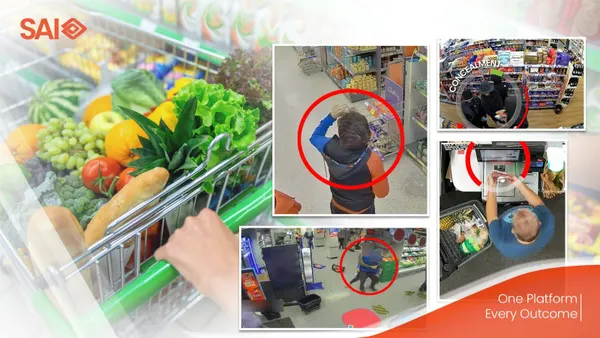
- Missed Scan: An item is moved past the scanner without being scanned.
- Product Stacking: Multiple items are scanned together as one.
- Product Switching: A cheaper item is scanned while a different item is bagged.
- Item in Hand: A shopper holds an item without scanning.
- Item in Basket: Items remain in the basket after scanning is complete.
- Incomplete Payment: The checkout flow is abandoned or payment is not completed.
Some of the above tactics also vary by store format and type of products. For instance, grocery stores may see more produce mislabeling, while home improvement and electronics retailers may face higher risks around barcode switching and concealment of high-value items. As a consequence, a one-size-fits-all program rarely works. Retailers need to analyze transaction data, video of events, exception reports, and incident logs to identify the most frequent loss patterns encountered at each location.
Strategies for self-checkout loss prevention
- Visibility: Self-checkout areas should be open, well-lit, and easy for associates to supervise. Avoid placing tall displays or promotional fixtures that block visibility for store staff as well as cameras. Cameras should cover scan zones, bagging areas, carts, and exits while respecting privacy and local regulations.
- Intelligent exception monitoring: Combine POS data with video analytics to identify events that deserve attention, such as skipped scans, barcode mismatches, unusual voids, or repeated assistance requests. This can reduce the burden on associates because they can focus on meaningful alerts instead of watching every transaction manually.
- Staff training: Associates should be trained to offer help early and intervene politely. The tone should remain customer-service focused: “Let me help you with that item” is usually more effective than confrontational language.
Other strategies to consider could include setting item limits and product restrictions. Also, it may be prudent to handle high-value, age-restricted, or frequently stolen items at staffed lanes. For grocery stores, image-based produce recognition, and clear product menus can reduce both errors and intentional mislabeling.
Importance of building a customer-friendly theft prevention program
Successful self-checkout theft prevention should feel like assistance, not punishment. Most shoppers are genuine and they want to pay and leave. Clear signage, intuitive screens, simple bagging instructions, and helpful prompts can prevent mistakes before they become losses.
When technology flags a potential issue, the message should be neutral and easy to resolve.
Transparency also builds trust. Retailers should explain that monitoring tools are used to improve accuracy, reduce errors, and keep prices fair. Policies should be consistent across stores, and teams should understand when to assist, when to escalate, and how to avoid biased or inconsistent enforcement.
How Visual AI can help prevent self-checkout loss
SAI’s visual AI platform offers comprehensive protection against SCO loss:
- Instant non-payment detection: Utilizes AI to instantly identify when customers avoid payments.
- Self-correction by customers: Delivers real-time prompts to the SCO monitor, allowing customers to self-correct without direct staff involvement.
- Empowered store staff: Keeps the store staff informed by sending notifications on the store’s hand-held terminals.
- Seamless SCO integration: Compatible with a range of self-checkout systems for straightforward multi-vendor integration.
By empowering customers to resolve issues independently and providing intelligent oversight, visual AI can reduce friction, minimize theft, and enhance the overall shopping experience. Retailers can reallocate staff to more complex tasks, improving customer service and operational efficiency.
How to measure success of a SCO theft prevention program
The best SCO theft prevention programs continuously improve based on data rather than assumptions. A number of data points can be used to track shrink by department, missed-scan recoveries, false alert rates, associate response times, customer satisfaction, and transaction speed. By comparing the results before and after changes such as AI alerts, staffing adjustments, layout improvements, or item restrictions provide a better picture on the efficacy of the theft prevention program.
Retailers should also review privacy and compliance requirements before deploying AI or video analytics. Many regions have strict rules around biometric data, surveillance notices, data retention, and customer consent. A privacy-first approach protects the business and helps maintain customer confidence.
Despite the risks, self-checkout is here to stay, but retailers must evolve their security strategies to match the risks. Effective self-checkout loss prevention combines AI loss prevention, trained associates, better store layouts, smart exception reporting, and customer-friendly processes. By focusing on prevention, accuracy, and service, retailers can reduce shrink without sacrificing the speed and convenience shoppers expect.
FAQ
Q. What is self-checkout loss prevention?
Self-checkout loss prevention refers to the strategies, technologies, and procedures retailers use to reduce theft, missed scans, fraud, and errors at self-service checkout lanes.
Q. How does AI help prevent self-checkout theft?
AI can compare scan activity, item movement, video signals, and POS data in real time. It helps identify suspicious events such as missed scans, barcode mismatches, and unusual transaction patterns.
Q. What are the most common self-checkout theft tactics?
Common tactics include item skipping, barcode switching, entering the wrong product code, leaving items at the bottom of the cart, and pretending to scan or pay without completing the transaction.
Q. Can self-checkout theft prevention affect customer experience?
If implemented poorly, self-checkout theft prevention can impact customer experience. The best programs use helpful prompts, polite associate support, clear signage, and accurate alerts so that honest customers are not inconvenienced unnecessarily.
Q. How can retailers know if their SCO theft prevention program is working?
To evaluate the efficacy of their SCO theft prevention program, retailers can track important data points such as shrink reduction, missed-scan recovery, false alerts, associate response time, customer satisfaction, transaction speed, and repeat incident patterns by lane, store, and product category.